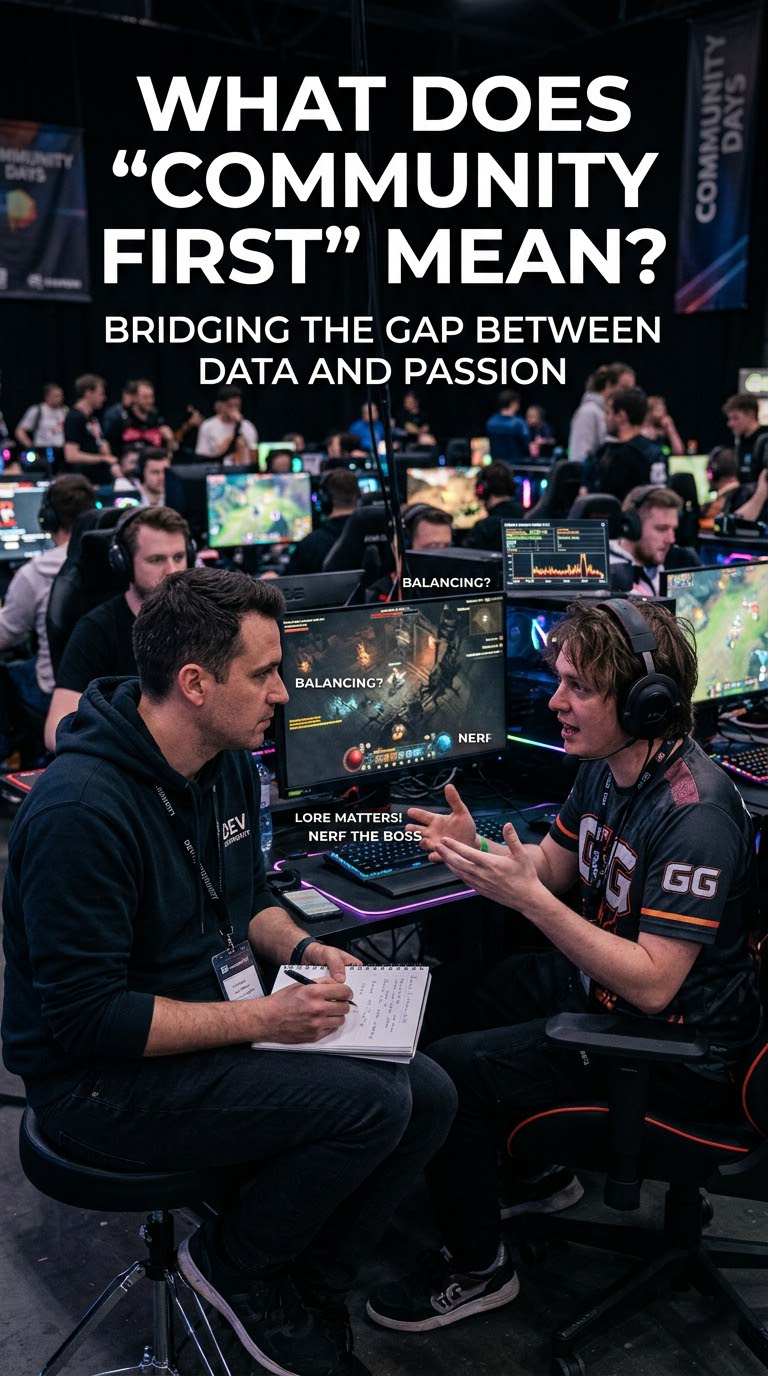
Many studios today adopt some version of the phrase "Community First." It’s a beautiful intent: the idea that a studio will walk hand-in-hand with its players, listening and evolving the game based on their voices.
Having worked with gaming communities since the ARMA 2 days, and communities in general since the 90s, I’ve seen this ideal both succeed brilliantly and fail spectacularly.
The problem? Like any piece of communication, "Community First" is open to interpretation.
- To some players, it sounds like a digital democracy where they hold the steering wheel.
- To some developers, it’s a way to describe being "present" on social media.
- To some marketers, if we’re being honest, it’s just another buzzword to strengthen a brand through empty lingo.
The Data Trap: Knowing "What" vs. Knowing "Why"
There is a growing trend of "Design by Data." Studios look at back-end metrics and telemetry to extrapolate player behavior. They think player actions are more relevant than player words.
Now, don't get me wrong: metrics are vital. They tell us what is happening. But they are notoriously bad at telling us why. If players are quitting a specific level, data tells you the exit point; it doesn't tell you if they left because it was too hard, too boring, or because a piece of dialogue felt like an insult to their intelligence.
Relying solely on mathematics to define a game's soul is how you end up with a product that is logically sound but emotionally vacant.
The "Defensive Wall"
In my curiosity, I’ve asked many colleagues: "How do you guys actually work with community feedback?" The answers can be provocative. I once had a developer tell me, "We don’t listen to the players; they’re idiots. Just don't tell them I said so."
It’s a harsh sentiment, but it reveals a deeper truth about our industry. The psychology of reading feedback on something you’ve poured your soul into is a minefield of hurt.
Calling players "idiots" is often just a defensive mechanism: a way to handle the "anti-personnel mines" of toxic comments. But a studio that retreats behind these walls is a studio that has already lost its way.
The Art of Active Listening
To me, "Community First" isn't about surrendering the design to a popular vote. It’s about presence and trust.
While I value a scientific approach: sending out forms and analyzing trends. My best work happens in the middle of the crowd. This requires Active Listening. It means:
- Withholding judgment during the heat of a "balanced" debate.
- Paraphrasing what is being said to ensure the player feels heard.
- Reflecting the emotions behind the feedback (recognizing the passion, even when it's wrapped in frustration).
This only works if you’ve established ground rules: constructive debate is the goal, and those trying to drown out other perspectives are firmly addressed.
The Great Balancing Act
Managing a community means looking at the full ecosystem. You have the lore enthusiasts, the 2% "min-maxers" who play 18 hours a day, the 80% casual base, and the content creators.
If you ignore that 2% of competitive players who find every exploit, your game's economy will crumble. But if you balance only for them, your 80% casual base will churn away before you can even ship a "damage control" patch.
Being Community First means knowing what the players want, understanding what they actually need, and having the guts to communicate why they can’t always have both.
Beyond the Jargon
Community work is a massive, multi-disciplinary machine. It’s advocating for players in high-level meetings, writing patch notes that actually make sense, encouraging cosplayers, managing ambassador programs, and translating complex dev-diaries into human language.
When a studio treats "Community First" as an actionable culture rather than a slogan, they move from jargon to action. When they don't? The void is quickly filled with toxicity and the "tone-deaf" label.
Real community development isn't about being "nice", it’s about being accountable.